Introduction:
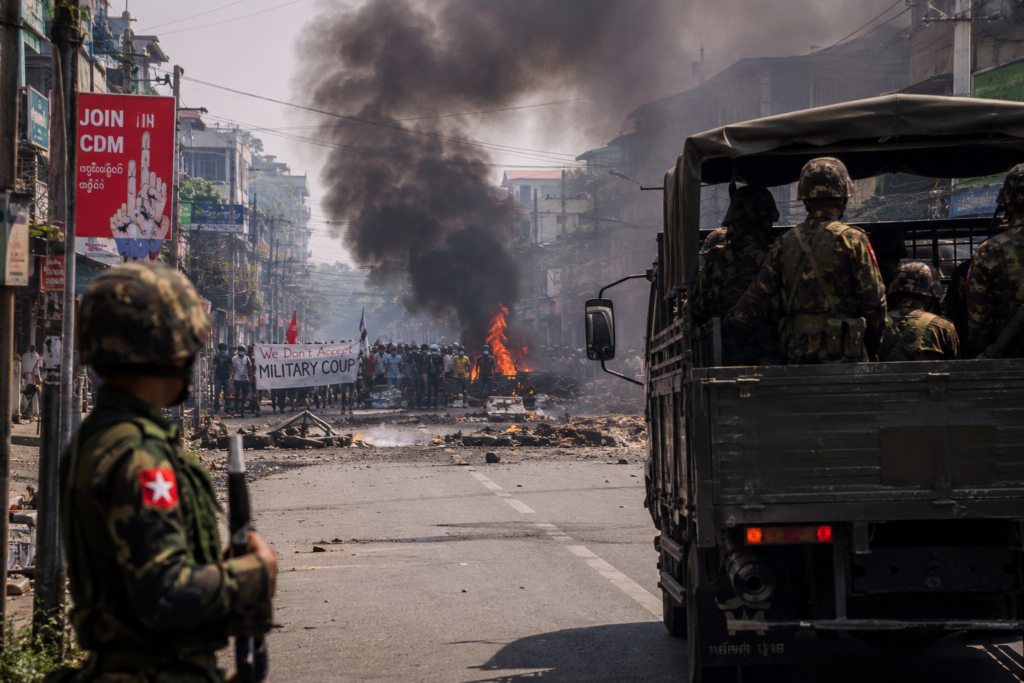
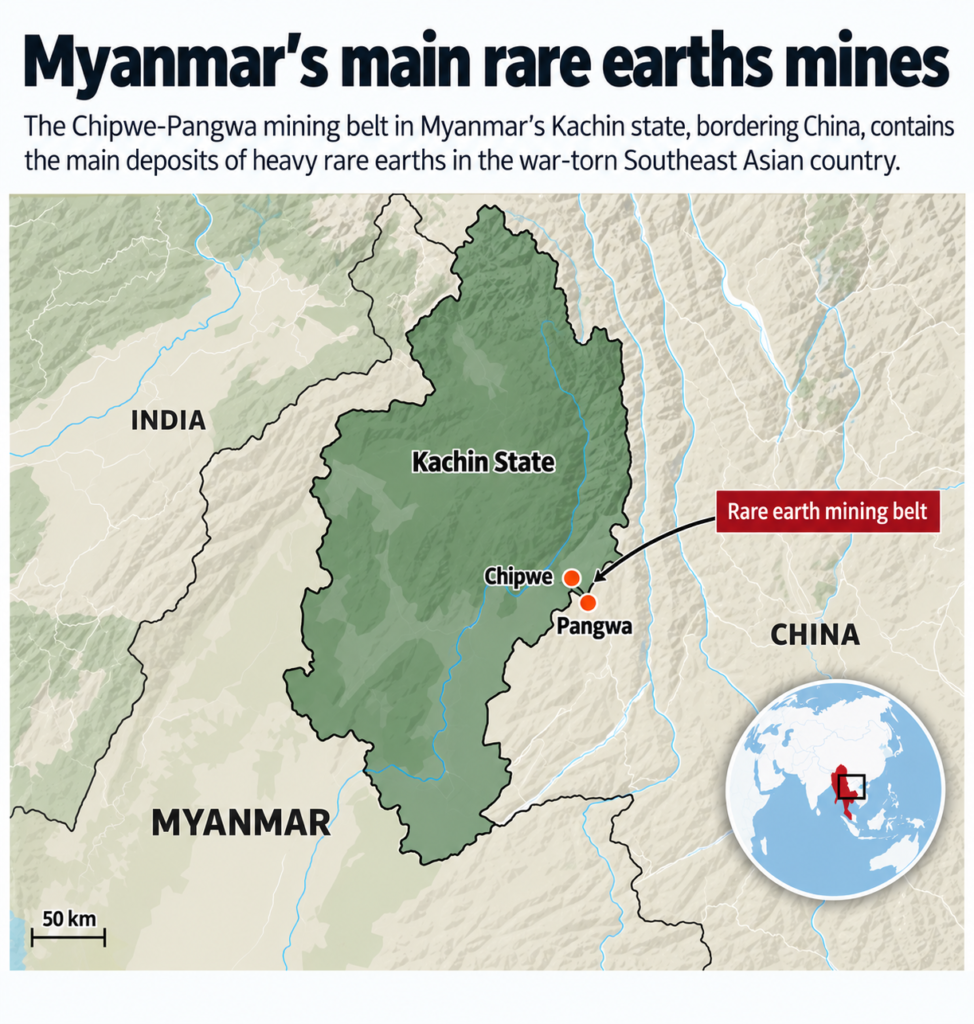
Myanmar has quietly become one of the most consequential—and least examined—nodes in the global critical minerals economy. The country reportedly supplies an estimated 40–50% of the world’s heavy rare earth elements (HREEs), particularly dysprosium and terbium, which are essential inputs for electric vehicle motors, wind turbine generators, and precision defense systems. Almost all of this production is concentrated in Kachin State, near the Chinese border, in territory that has shifted hands between the military, also called the Tatmadaw, the Kachin Independence Army (KIA), and allied ethnic militant groups since the 2021 coup, as extensively documented by a Chiang Mai-based think tank on Myanmar.
The conventional framing of critical minerals geopolitics centers on state-to-state competition—the United States and China racing to lock up supply, or resource nationalism among producer governments. Myanmar disrupts this framing. Here, the decisive actor is not a government ministry but an armed ethnic organization controlling mining concessions, taxation, and export routes. This article argues that in conflict-affected producer states, geopolitical leverage over critical minerals is exercised through control of extraction and logistics corridors, not through sovereign ownership, and that this distinction carries direct, underappreciated consequences for corporate risk management.
Strategic Weight of Heavy Rare Earths:
Dysprosium and terbium are irreplaceable in high-performance permanent magnets used in EV traction motors and offshore wind turbines, and they have no scalable substitutes at commercial cost, per the International Energy Agency’s critical minerals analysis. China controls roughly 85–90% of global rare earth processing capacity regardless of where the ore originates, meaning Myanmar’s mined output is shipped north to Chinese separation facilities before re-entering global supply chains as refined metal, as detailed by the United States Geological Survey. This creates a compounding chokepoint: geological concentration in Myanmar and processing concentration in China.
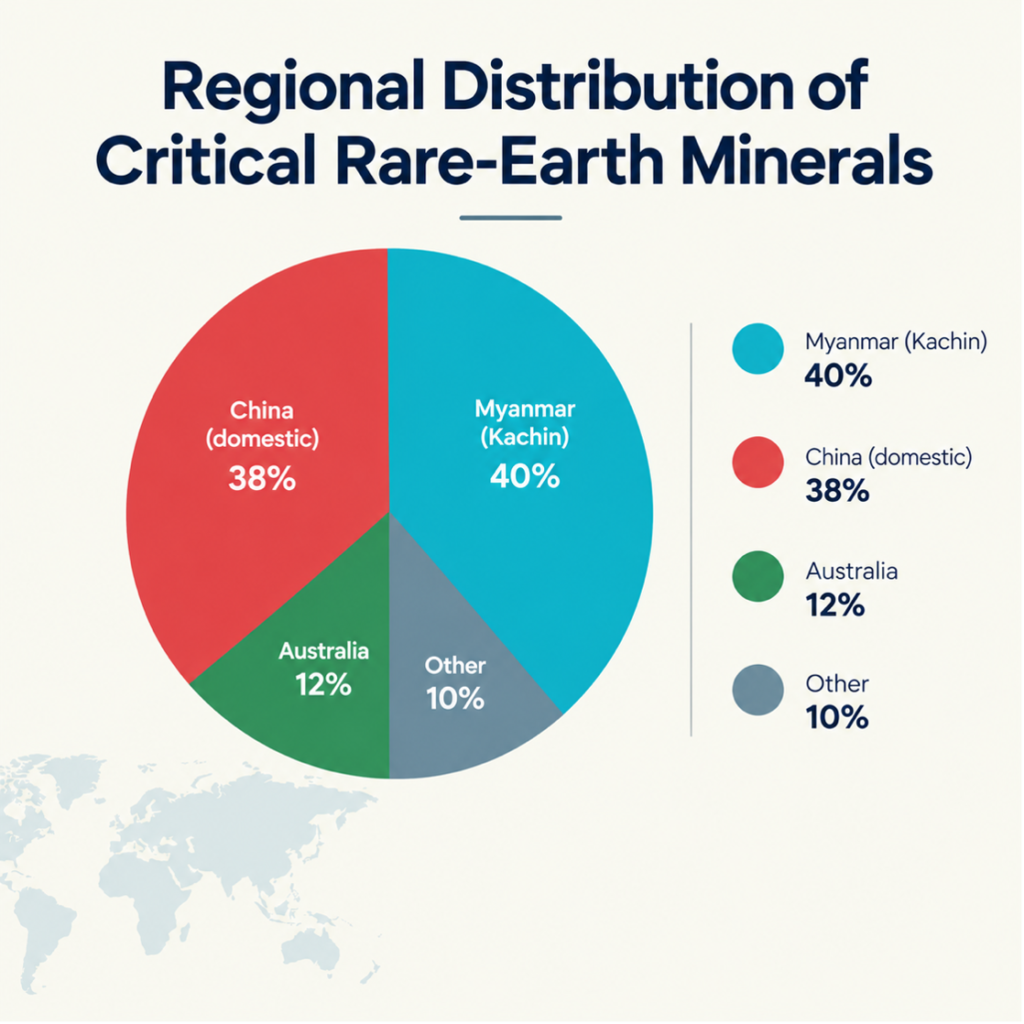
Figure 2: This infographic is AI-generated and intended for illustrative purposes only
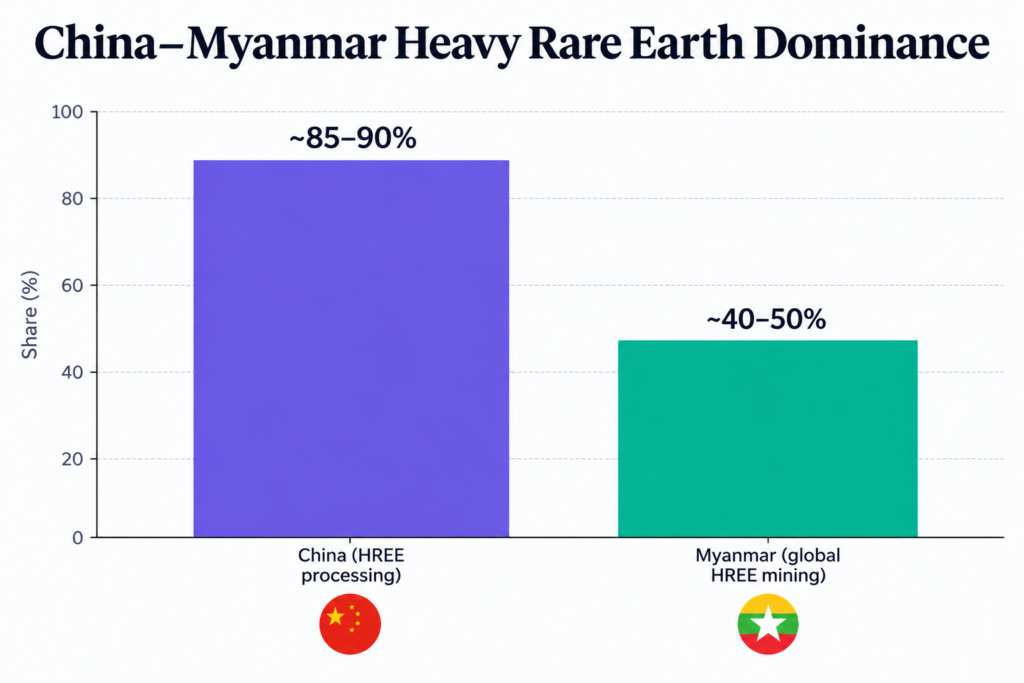
Figure 3: Global Rare Earth Chokepoints: Two Separate Concentrations, 2024–2025
China occupies two distinct positions in Myanmar’s rare-earth economy. It is the principal destination for Myanmar’s upstream material and the dominant location for separation, refining, alloy production, and permanent-magnet manufacturing. This gives Chinese firms and authorities leverage over both the commercial value of Myanmar’s minerals and the conditions under which those minerals enter global markets.
China’s role is not limited to purchasing ore. Border crossings, customs procedures, import licensing, provincial trading networks, and processing capacity determine whether material extracted in Kachin can be converted into commercially usable products. Chinese authorities can therefore influence supply without directly controlling every mine. A temporary border closure, tighter customs inspection, or revised import requirement can have effects similar to a production stoppage.
This creates an important asymmetry. The KIA or another armed ethnic group can control the mine and the immediate road network, but Chinese authorities retain significant leverage over the external market into which the material is sold. Myanmar-based actors control access to the resource; Chinese institutions control much of the resource’s route to global industrial value.
China’s diplomatic engagement with Myanmar’s armed actors should therefore be assessed partly through the lens of resource security. Reuters reported in July 2025 that the global heavy-rare-earth supply chain was affected by fighting in Kachin and by Beijing’s efforts to manage the consequences of conflict near the Chinese border.
Since 2021, Kachin-sourced HREE feedstock has become an increasingly important input for Chinese magnet manufacturers precisely as Beijing has tightened its own domestic mining quotas for environmental reasons, as reported by state run Global Times. This makes Myanmar’s mines an informal release valve for Chinese industrial policy, and it means disruptions in Kachin State propagate directly into EV and clean energy manufacturing timelines in China, Japan, and South Korea.
Territorial Fragmentation and the Governance of Extraction:
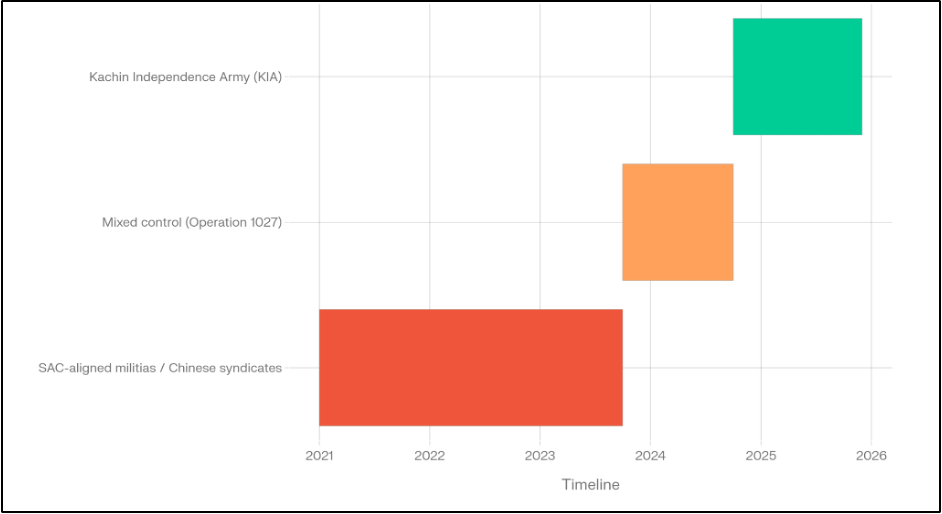
The mining areas of Chipwi and Momauk townships in Kachin State have functioned under overlapping and contested authority since 2021. The KIA, historically opposed to unregulated rare earth mining on environmental and sovereignty grounds, took control of key mining zones from military-aligned militant groups in late 2024, disrupting an industry previously taxed and permitted informally by the Tatmadaw and its proxies, such as Shanni Nationalities Army (SNA), local Lizu, Rawang, Warazup, Khao Lan Pu groups, and Border Guard Force.
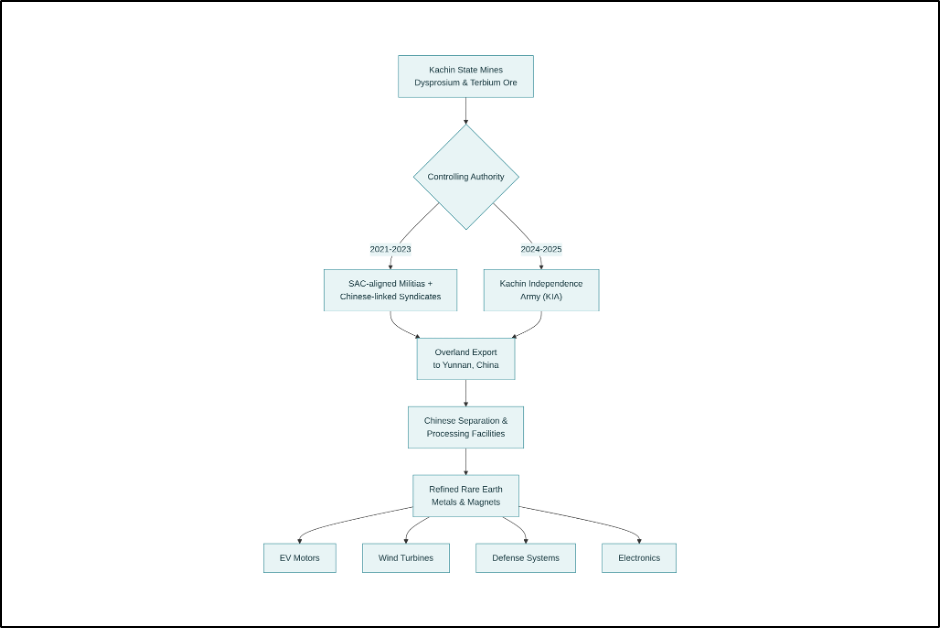
(Figure 4: Flowchart: Supply Chain & Governance Path)
Callout on “Controlling Authority” box: “Governance shifts here directly change downstream cost and availability; this is the chokepoint invisible to Tier 1–2 buyers.”
As such, rare earth extraction in Myanmar has never operated through a single, coherent regulatory authority. Instead, it has moved between at least three governance regimes since 2021—SAC-aligned border guard forces, informal Chinese-linked mining syndicates operating with local militia protection, and now KIA administration—each with different taxation, environmental enforcement, and export approval practices. When the KIA imposed new restrictions and taxation on mining operators in late 2024 and again in 2025, cross-border shipments to China reportedly slowed, contributing to price spikes in dysprosium oxide on international markets.
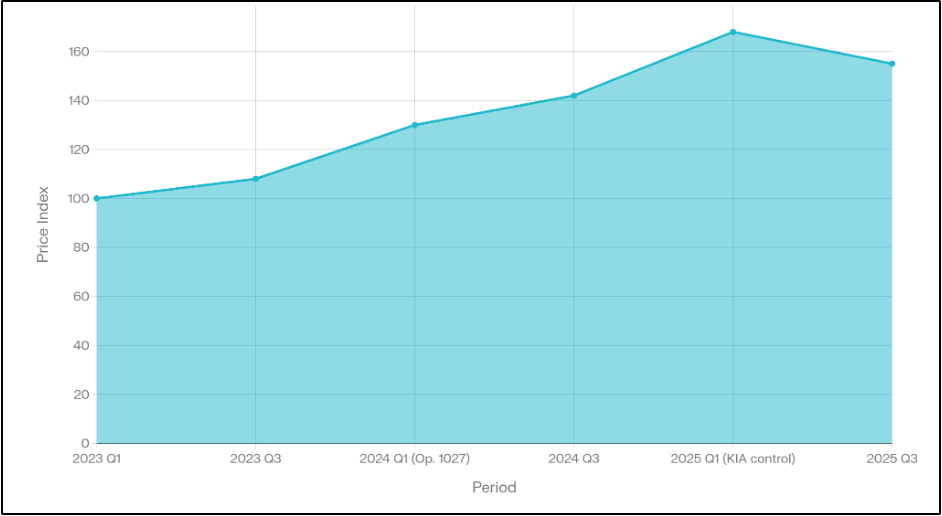
(Figure 5: Dysprosium Price Index Rises with Kachin Instability, 2023-2025)
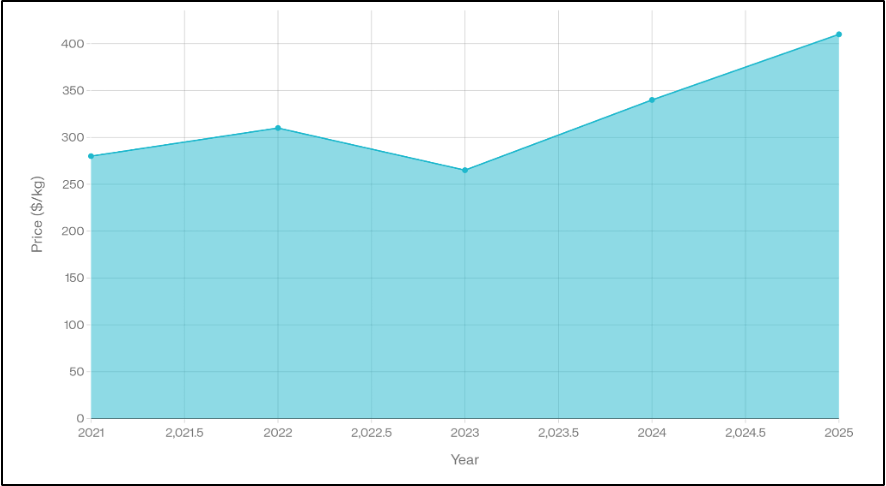
(Figure 6: Dysprosium Oxide Prices Rose 46% since 2021)
This is not a market disruption external to the resource economy, it is the resource economy. Whoever controls the townships controls the taxation rate, the environmental compliance regime, and the border crossing. Corporate buyers on several tiers removed in the supply chain are nonetheless exposed to the outcome of an internal Kachin power struggle they have no visibility into and no contractual relationship with.
Table 1: Governance Regimes Over Kachin Rare Earth Mining, 2021–2025
| Period | Controlling Authority | Taxation/Permitting Approach | Export Routing |
| 2021–2023 | SAC-aligned militias, informal Chinese-linked syndicates | Informal levies, minimal environmental enforcement | Direct overland to Yunnan Province |
| Late 2023–2024 | Mixed control amid Operation 1027 offensives | Disrupted, inconsistent | Intermittent border closures |
| Late 2024–2025 | Kachin Independence Army (KIA) | Formal taxation, new environmental restrictions, licensing reviews | Slowed, subject to KIA approval |
Source: Compiled from Global Times and Reuters reporting on Kachin rare earth governance transitions, 2024–2025.
Corporate Risk Implications: From Sourcing to Governance Literacy:
For corporations in EV, wind energy, electronics, and defense supply chains, Myanmar’s case demonstrates that supplier diversification alone is an insufficient risk strategy. A firm may successfully diversify away from a single mine while remaining fully exposed to Kachin-origin material laundered through Chinese processing facilities that obscure upstream provenance. Traceability, not just diversification, is the operative requirement, and traceability is precisely what conflict-zone extraction defeats by design, since none of the governing authorities maintain internationally auditable chain-of-custody documentation, a gap flagged by the OECD’s due diligence guidance on conflict-affected mineral supply chains.
Four risk categories deserve direct attention from corporate risk and procurement functions:
- Supply concentration risk: A material share of global HREE supply passes through a single conflict-affected district, creating a chokepoint invisible in standard supplier-tier mapping.
- Regulatory and sanctions exposure: Incoming EU conflict minerals-style due diligence frameworks and rising US disclosure requirements increasingly scrutinize rare earths. Therefore, firms sourcing indirectly through Chinese intermediaries face rising obligations they may not yet be prepared to meet.
- Reputational risk: Environmental damage from unregulated rare earth operating in Kachin State, documented by Global Witness, creates ESG exposure for downstream brands even when sourcing several intermediaries is removed.
- Political dependency risk: Because extraction legality and taxation are set by whichever armed actor holds ground, contractual certainty with any single mining operator is inherently temporary and non-enforceable in ordinary commercial terms.
Conclusion:
Myanmar illustrates a broader shift in how geopolitical leverage over critical minerals actually operates in fragile states: not through treaties or export licenses issued by a recognized government, but through contested control of townships, checkpoints, and border crossings. For corporate risk functions, the lesson is that resource security in the next decade will depend less on counting supplier contracts and more on understanding the political geography beneath them. Firms that build genuine governance literacy into their sourcing due diligence (mapping not just where minerals come from, but who actually controls that ground) will be structurally better positioned to anticipate the next supply shock than those relying on diversification metrics alone.
Note: This publication is part of SSCIRRA’s Research Article Competition, in which Aman Semwal secured the Runner-Up position.