Introduction
Japan’s two tungsten hexafluoride (WF₆) manufacturers announced permanent closure, forcing South Korea to look for alternatives ranging from turning to Chinese supplies and enhancing domestic capabilities to reopening the Sangdong mine. Yet whether these strategies could achieve supply chain diversification remains to be seen. If South Korea replaces Japanese WF₆ production while depending on Chinese supplies, to what extent does this represent genuine supply diversification, or is it more of a supply restructuring given China’s upstream dominance?
Japan’s WF₆ Closure
On July 1, Japan’s semiconductor industry lost two major domestic sources of tungsten hexafluoride (WF₆), a speciality gas used to deposit tungsten in advanced DRAM, 3D NAND and high-bandwidth memory (HBM) chips. Central Glass Co., Ltd and Kanto Denka Co., Ltd have permanently halted production after months of difficulties in securing sufficient inventories.
The closures followed Japan’s reduced access to Chinese tungsten after China tightened export controls. On January 6, China extended restrictions on all dual-use items destined for Japan’s military end-users and military applications, due to deteriorating China-Japan relations. Japan began to feel the immediate impact in February, as Chinese exports of tungsten products to Japan fell to zero for three consecutive months. In April, Japan’s imports decreased by approximately 50% compared to the monthly average for 2025.
As the two Japan-based affected companies accounted for a 25% share of global WF₆ production capacity, this raised imminent concerns about supply shortages in the semiconductor industry and affect international markets. The impact is significant enough to extend beyond the domestic industry. More importantly, the consequences of Japan’s permanent shutdown may extend beyond Japan.
From Japan’s Retreat to South Korea’s Response
Japan’s production shutdown created an immediate problem for South Korea’s semiconductor industry. South Korea-based companies, especially Samsung Electronics and SK Hynix, previously sourced up to 80% of their WF₆ supplies from Japan. The disruption also coincided with soaring tungsten prices. From April to May, prices of tungsten-related materials reportedly spiked by 70-90% for WF₆, and Samsung was reportedly uncertain whether its inventory could last through June. For semiconductor manufacturers, the loss of a specialized material makes sourcing and procurement difficult.
Due to soaring prices and inventory shortages, South Korean companies have been looking for ways to expand their sourcing. Some are turning to domestic precursors (SK Specialty, Foosung) or other sourcing alternatives. For instance, SK Specialty has reportedly signed a long-term contract to supply Samsung with 150 tons of WF₆ per month. Such an arrangement helps reduce the dependence on Japanese suppliers. Foosung, meanwhile, is taking a different approach. The company has started certification with China’s CSSC Speciality Gases, with large-scale WF₆ imports targeted for August. Rather than waiting for Japan to resume its production, South Korea is moving to fill the gap left by Japanese suppliers with Chinese alternatives.
Meanwhile, South Korea has also started building its upstream supply capabilities. Sangdong Mine in Gangwon Province has recently resumed production after more than 30 years. Operated by Canada-based Almonty Industries Inc, the mine began feeding stockpiled run-of-mine ore in June 2026. The first phase is designed to yield 2,300 tonnes of tungsten concentrate annually, while the second phase plans to double tungsten output in 2027.
The restart of the Sangdong Mine aims not only to increase domestic production capacity, but also to restore domestic source further upstream in the supply chains.
China’s Upstream Advantage
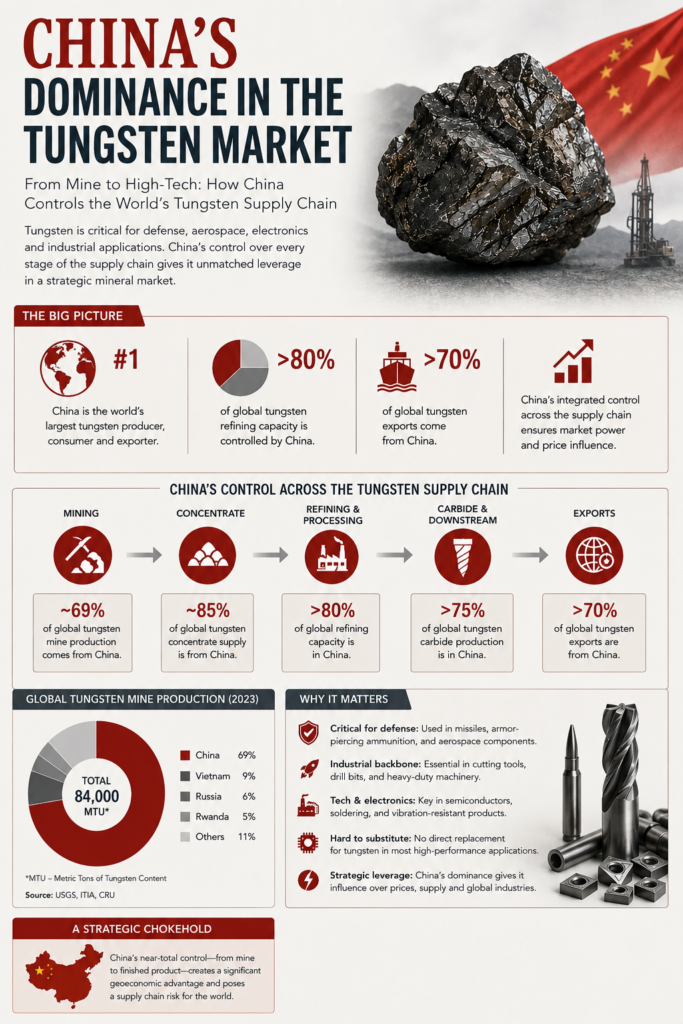
Not every country is similarly affected by the production halt of those two Japan-based companies. China leads the global tungsten market in mining, processing and refining capacity. It produces 80% of the tungsten powder and holds half of the world’s reserves.
Alongside its upstream domination, China has also gained a strong foothold in processing tungsten powders and ammonium paratungstate (APT), which are essential for producing WF₆ used in defense, automotive and semiconductor sectors. For instance, China-based companies like Xiamen Tungsten, China Tungsten and Hightech Materials are among the few companies capable of produccing large quantities of 6N-grade high-purity tungsten powder. Such dominance gives Chinese producers greater influence across the global tungsten supply chains.
At the same time, China’s domestic WF₆ supply is increasing. Industry sources estimated that CSSC Specialty Gases would reach a WF₆ production capacity of 2,000 tons/year by the end of 2025, with purity reaching 6N levels, and the product entering the supply chains of global chipmakers. China’s role is not limited to being just an upstream tungsten supplier, but is also expanding its downstream specialty gas capabilities.
In other words, China’s strategic position lies in its control of various upstream stages, rather than merely its large tungsten reserves. Any upstream changes, or trade restrictions and import quotas imposed by China, are likely to be transmitted to semiconductor manufacturing processes.
Diversification or Redistribution?
South Korea’s response illustrates different layers in the supply chain. SK Specialty is expanding its role as a domestic WF₆ supplier. By contrast, Foosung is turning to China to enhance its production capacity, while the Sangdong Mine suggests the country is reestablishing upstream tungsten sources. These three strategies reflect short- and long-term adjustments. SK Specialty addresses supplier concentration; importing from China by Foosung can reduce immediate supply shortages, while rebuilding the mine aims at reducing long-term dependence on external resources.
Although South Korea seems to have different alternatives to achieve diversification, these methods are not entirely independent of China. Even if the WF₆ production moves from Japan to South Korea, it does not mean upstream sources will also shift to South Korea. As long as South Korean WF₆ production requires tungsten powder and other upstream materials from China, the core supply chain does not automatically disappear.
The major difference is that China’s export control has so far mainly targeted Japan following deteriorating bilateral relations, while South Korea is not similarly affected at this stage. To some extent, South Korea’s supply security depends on whether China continues to allow tungsten exports. This implies geopolitical factors will play a crucial role in determining supply security.
Therefore, receiving supplies from China, as Foosung did, can temporarily fill the void left by Japan’s closure, but a paradox exists: It reduces direct dependence on Japan, while increasing China’s importance in its supply chains.
Conclusion
Japan’s retreat has shaped the semiconductor materials supply chain in East Asia. At first glance, South Korea appears to be reducing dependence on Japanese WF₆ suppliers, but the underlying vulnerability of the supply chains still remains, as long as the upstream resources are still concentrated in China. Hence, Japan’s retreat looks more like a redistribution of supply chains rather than a complete diversification. The geographical location of production can change, but the dependency relationship may not, and the supply chain vulnerability may therefore be shifting from one place to another.