Introduction
The Myanmar military’s reported advance into Saw town in Gangaw District, Magway Region, on 17 May should be assessed within the context of broader efforts to regain operational access and reinforce military presence across northwestern Myanmar. Recent battlefield developments, including the military’s recapture of Falam in Chin State in April and earlier operations around Indaw in Sagaing Region, indicate sustained attempts to reassert control along key transport routes linking Sagaing Region, Magway Region, and Chin State.
The fighting around Saw is strategically significant because Gangaw District functions as an important access corridor between central Myanmar and the Chin highlands. Routes through the Yaw region influence movement between Magway Region, Sagaing Region, and southern Chin State, making the area strategically important for both the military and resistance groups from an operational point of view.
Context
Saw is located within the Yaw region of Gangaw Township, an area that has experienced persistent clashes since armed resistance expanded following the 2021 coup. Gangaw District connects Magway Region with southern Chin State, including routes toward Kanpetlet and Mindat, and has consequently become an important transit and operational zone for multiple resistance formations.
The region has long hosted activity by local resistance groups, including Yaw-based armed formations and People’s Defence Forces (PDFs), many of which coordinate with Chin resistance actors operating across the Magway-Chin frontier. Resistance activity in the broader Gangaw-Saw corridor has repeatedly disrupted military movement, ambushed convoys, and constrained the military’s ability to move securely between central Myanmar and Chin State.
The military’s reported advance into Saw likely reflects efforts to improve security along transport routes and limit the freedom of movement of resistance forces across the frontier belt. Reporting from May additionally indicated troop deployments north of Saw and along approaches leading toward Chin State, suggesting the operation forms part of wider military activity across northwestern Myanmar rather than an isolated maneuver.
The timing is also notable given the approaching monsoon season, which historically constrains military mobility in western Myanmar. Heavy rainfall frequently damages roads, delays military reinforcements, complicates logistics, and limits sustained ground offensives in mountainous terrain. The current push, therefore, likely reflects attempts to secure tactically important positions and road access before operational conditions deteriorate.
Relevance of capture of Falam
The military’s recapture of Falam on 25 April represented one of the significant battlefield reversals suffered by Chin resistance groups, primarily the Chin National Defence Force (CNDF) and its allies within the Chin Brotherhood (CB) coalition, in recent months. Falam had reportedly remained under resistance influence since 2025 and was viewed as an important resistance-held urban center in northern Chin State.
Reporting surrounding the operation indicates that the military relied extensively on airstrikes during the campaign, targeting resistance defensive positions in and around the town as well as surrounding elevated terrain. The operation again highlighted the military’s continued dependence on aerial support to offset the challenges of conducting ground offensives in rugged areas where resistance groups possess superior terrain familiarity and decentralized defensive networks.
Falam’s strategic relevance stems primarily from its location along routes linking the military’s Regional Operations Command in Kalay Town, Sagaing Region, with Hakha City in Chin. Supply to Falam and northern Chin arrives mainly from Mandalay via Kalay in Sagaing Region or Gangaw in Magway Region, making the Kalay-Falam-Hakha corridor a critical artery for both military logistics and civilian commerce. The town is also situated near Surbung Airport, one of the limited aviation facilities in Chin State. Proximity to aviation infrastructure could also be a motivation, as it could improve the military’s logistical flexibility and aerial access in areas around Falam.
The recapture of Falam, together with operations in Sagaing and Magway, indicates broader military efforts to restore access to areas where resistance groups expanded influence over the past several years. However, military control across Chin State remains fragmented, with resistance groups continuing to retain influence across multiple rural and mountainous areas despite recent military gains in selected towns.
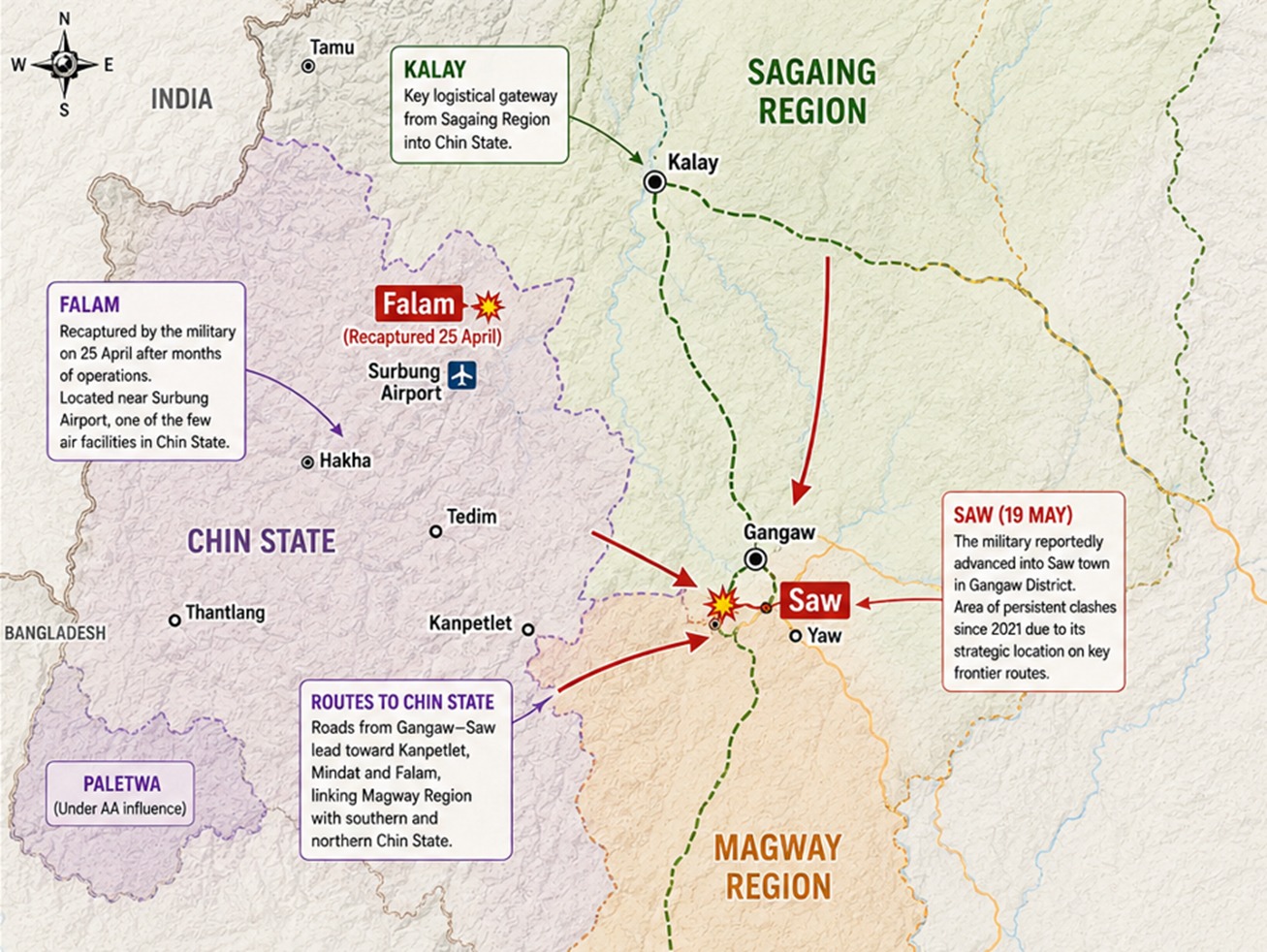
This map is AI-generated and intended for illustrative purposes only
Operational Priorities
Current military activity across northwestern Myanmar appears focused on restoring more reliable access between military-held urban centers and contested frontier zones instead of establishing a total territorial dominance across all resistance-held areas.
Kalay in Sagaing Region continues to serve as a key logistical gateway toward Chin State, while Gangaw and Saw remain important access points between Magway Region and the Chin hills. Operations around these areas likely aim to improve military movement along road networks that have faced repeated disruption from resistance ambushes, checkpoints, and attacks since 2021.
Recent offensives more plausibly indicate attempts to stabilize vulnerable transport routes, reinforce isolated military positions, and reduce the ability of resistance groups to interdict movement between central Myanmar and Chin State. This is particularly important for sustaining troop rotations, transporting supplies, and maintaining access to administrative centres in contested frontier regions.
At the same time, resistance groups continue to retain substantial operational mobility outside major roads and urban areas. Even where the military regains control over towns or transport corridors, maintaining durable control over surrounding rural terrain remains difficult due to the geographic advantages provided by western Myanmar’s mountainous terrain.
Airpower and Drone Dependence
Recent operations in Chin State and Magway Region continue to underscore the military’s reliance on airpower to support ground offensives. Resistance groups have consistently reported airstrikes accompanying military advances, particularly during operations targeting elevated defensive positions.
The conflict has also seen increased drone usage by both the military and resistance actors for reconnaissance and attack purposes. Reports indicate that drone deployment has expanded across Myanmar’s civil war since at least 2023.
For resistance groups operating in Chin State and Magway, the growing integration of aerial reconnaissance and air-supported operations reduces some of the defensive advantages historically provided by rugged terrain and guerrilla-style manoeuvre tactics. However, resistance actors continue to rely heavily on mobility, local support networks, decentralized command structures, and rapid withdrawal tactics to avoid prolonged positional warfare against better-armed military forces.
Despite this, a large part of the military’s troops remain tied down by a protracted and fragmented counterinsurgency across Magway, Sagaing, and adjacent regions, while no single resistance group currently possesses the capability and intention to decisively shift the nationwide conflict balance. As such, northwestern Myanmar is likely to remain a contested area characterized by periodic shifts in territorial control.
Chin-Magway Pressure Before Monsoon
Military pressure along the Chin-Magway frontier intensified throughout May, with reports of troop movements across northern Magway and continued clashes in Chin State. These operations likely reflect efforts to consolidate recent gains before seasonal weather conditions reduce operations.
The monsoon season has historically imposed constraints on military operations in western Myanmar due to flooding, landslides, poor road conditions, and reduced ground mobility. Resistance groups have often benefited from these conditions because smaller decentralized formations can manoeuvre more effectively through difficult terrain than conventional military columns dependent on road access and heavier logistical support.
As a result, the military likely seeks to reinforce key towns, secure transport corridors, and strengthen defensible positions before sustained monsoon conditions limit operational tempo.
Infrastructure Considerations
Magway Region contains sections of the China-Myanmar oil and gas pipeline network linking Rakhine State with China’s Yunnan Province. Security surrounding this infrastructure has remained sensitive since the conflict expanded across central and western Myanmar following the 2021 coup. Since then, Beijing has repeatedly pressured Myanmar’s military to tighten security along the China-Myanmar oil and gas pipeline, warning that any damage to the Belt and Road Initiative project could cause major financial losses and undermine investor confidence.
Although there is limited direct evidence linking current operations around Saw specifically to pipeline protection, improved military control over transport routes in Magway could indirectly strengthen security conditions surrounding the aforementioned infrastructure.
Conclusion
The military’s reported advance into Saw should therefore be understood within the broader context of efforts to restore military access and reinforce operational presence across northwestern Myanmar. Recent offensives in Falam, Indaw, and Gangaw District collectively indicate sustained attempts to stabilize transport corridors linking Sagaing Region, Magway Region, and Chin State following years of expanding resistance activity.
At the same time, available evidence does not indicate that the military has established durable territorial dominance across the region. Resistance groups remain operationally active across large parts of Chin State, Sagaing Region, and Magway’s frontier areas, while control in many zones continues to shift.
Nevertheless, recent operations demonstrate the military’s continued ability to reinforce contested urban centres and leverage airpower to regain access to strategically important frontier corridors, particularly ahead of the operational constraints imposed by the approaching monsoon season.