Background, Strategic Importance and Infrastructure Investment
The militarization of the Andaman and Nicobar Islands is not a recent development; in fact, the islands were an important naval base for the historically powerful Chola dynasty. However, in modern times, India’s first integrated tri-service command, the Andaman and Nicobar Command (ANC), was established in 2001, with headquarters in Port Blair. This establishment was a strategic step taken by former Prime Minister Atal Bihari Vajpayee as part of India’s formerly “Look East” policy, which later transformed into the “Act East Policy.” The ruling Bhartiya Janata Party’s (BJP) Great Nicobar project is the most ambitious continuation of that legacy yet, but why does an island that covers only 0.2% of India’s land still make up for 30% of the Exclusive Economic Zone (EEZ)?
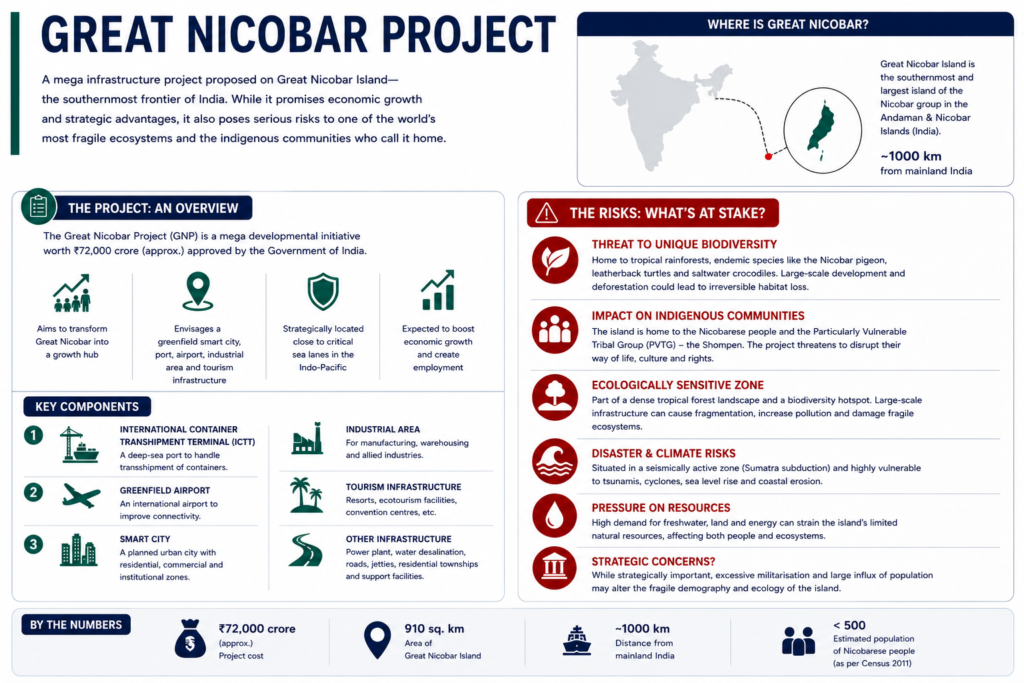
After receiving the green light from the Union Cabinet in 2021, the project covered 166 sq km and combined four massive components: a transshipment port at Galathea Bay capable of handling up to 14.5 million TEUs annually ,a greenfield international airport with a 3,300-metre runway for dual civil and military use, a 450 MW power plant, and a planned township for up to 65,000 residents. Great Nicobar is now officially the 13th ‘major‘ port of India. Phase 1 of the port is to be commissioned by 2028, with an estimated cost of INR 19,000+ crore. The project is the physical manifestation of India’s Act East Policy, and located only 80 nautical miles from Indonesia, it encourages a cooperative maritime and economic coordination with ASEAN partners.
Note: This infographic is AI-generated and intended for illustrative purposes only
The Malacca Strait: Economic Advantage and Supply Chain Control
Great Nicobar is located approximately 40 nautical miles from the strategic Malacca Strait, an international shipping channel that handles approximately 35% of global sea trade and serves as the key segment of the East-West maritime trade corridor. The islands run some 800 km from the top of Indonesian Sumatra to Myanmar, positioning India to dominate the western approaches to the Strait, just as China’s artificial islands in the contested South China Sea dominate the sea lanes at the other end. Retired Brigadier Arun Sahgal captured the urgency precisely, calling it the ‘Hormuz Strait effect’: the idea that waterways can be militarily dominated, and that Nicobar must become a credible outpost so that no inimical player interferes in maritime traffic in the manner being done by both Tehran and Washington in Hormuz during the Iran-US/Israel War.
The economic argument is equally compelling. Currently, nearly 75% of India’s transshipped cargo is handled at ports outside India-Colombo, Singapore, and Klang handle over 85% of this, with Colombo alone accounting for 45%. Every container rerouted through a foreign hub carries a surcharge of roughly 200–300 USD per TEU and 1.5 to 3 extra days at sea. In a world where supply chains are increasingly being weaponized, this dependence becomes a strategic liability. India’s existing bunkering ports in Jawaharlal Nehru Port Authority (JNPA), Cochin, and Chennai are not situated on major international trade routes, while Singapore supplied 48 Mt of fuel in 2022 alone. The Galathea Bay port aims for a turnaround time of 18–22 hours compared to Colombo’s 30 hours — a 40% reduction that could yield 8–12 billion USD annually across India’s export-import matrix. The government estimates a project of Rs 30,000 crore in annual revenue by 2040, with 50,000 jobs created.
Counterbalancing China: String of Pearls, CPEC, CMEC and the Indo-Pacific
China’s “String of Pearls” describes Beijing’s expanding network of maritime, port, logistics and diplomatic investments across the Indian Ocean Region (IOR). First articulated in strategic literature in the mid-2000s, the concept refers to Chinese access points—commercial ports, container terminals, logistics hubs, naval resupply facilities, and defense-related agreements—located in Pakistan, Sri Lanka, Myanmar, the Maldives, and elsewhere. While many of these projects are officially civilian and driven by trade and Belt and Road Initiative (BRI) economics, their dual-use characteristics and host-state agreements create latent military and political leverage that can be activated under deteriorating strategic conditions. Key examples include Gwadar Port (Pakistan) and Hambantota Port (Sri Lanka), which provide maritime access and logistics capacity that could support sustained naval presence or influence regional maritime routes. Recent academic and policy reporting shows a pattern in which commercial port investments generate follow-on security cooperation, basing arrangements, or port-operational control that increases Beijing’s operational reach and diplomatic bargaining power in the IOR.
Considering the latent security concerns in New Delhi, India responded with the “Necklace of Diamonds” — a dispersed network of partnerships and infrastructure projects intended to secure sea lines of communication and provide alternatives to Chinese-linked facilities. India’s approach blends bilateral infrastructure finance, defense cooperation, port development (including investments in the ANC), and multilateral engagement through mechanisms such as the QUAD and enhanced cooperation with ASEAN states. The “double fishhook” metaphor used in some Indian strategic commentary refers to complementary northern and southern chains of partnerships intended to interlock across the eastern Indian Ocean and protect the western approaches to the Malacca Strait.
China’s Malacca Dilemma is urgent: close to two-thirds of all Chinese maritime trade passes through the Strait, including around 80% of its oil imports, through a channel only 2.8 km wide at its narrowest point (Atlas Institute, 2025). As a way to tackle this vulnerability, Beijing has invested billions in the China-Pakistan Economic Corridor (CPEC) and the China-Myanmar Economic Corridor (CMEC). Both, however, remain unreliable despite the hefty investments of China: CPEC faces political instability in Pakistan and Balochistan Liberation Army (BLA) militant attacks killing Chinese engineers, while CMEC’s Myanmar pipelines have been severely disrupted by the militant groups, primarily the Arakan Army in Myanmar’s Rakhine State, since the 2021 civil war in the country. Hence, China’s options remain restricted, reinforcing the strategic value of India’s ANC position. In 2019, the Indian Navy used the ANC’s surveillance system to interdict the Chinese research vessel Shiyan-1, which had entered the archipelago’s EEZ without consent, emphasizing that ‘China’s presence in the Indian Ocean is increasing,’ as mentioned by then-Naval Chief Admiral Karambir Singh. As such, while China has increased maritime access, the evidence of permanent overseas military bases in the IOR remains limited; most facilities retain primarily civilian governance or commercial operators. However, dual-use infrastructure, exclusive long-term port leases, or logistics agreements raise the risk that these nodes could be repurposed for military use or coercive diplomacy in a crisis. Further, competing investments, contested maritime claims, and episodic naval encounters increase the chance of diplomatic friction or localized security incidents. The transformation of commercial facilities into active military logistics hubs is plausible over a multi-year horizon, particularly where governance or financial distress enables Beijing to gain operational control.
Risks involved: Environment, Seismic Hazard, Indigenous Rights and Budget
New Delhi’s strategic rationale underpinning the development of Great Nicobar is difficult to dispute; however, the project entails significant environmental and socio-political risks that warrant careful consideration. The island forms part of the Sundaland Biodiversity Hotspot—one of only four such hotspots in India—and was designated a UNESCO Biosphere Reserve in 2013. It encompasses critical habitats for numerous endemic and vulnerable species, including the Nicobar megapode, leatherback turtles, coral ecosystems, migratory birds, and the Nicobar crab-eating macaque. The proposed development is expected to require the clearance of approximately 131 km square of tropical rainforest (Andaman and Nicobar Administration), raising concerns regarding irreversible ecological degradation.
Beyond its environmental significance, Great Nicobar possesses considerable cultural and indigenous importance. With the exception of seven revenue villages, the island constitutes a protected reserve for the Shompen—a particularly vulnerable tribal group numbering approximately 229 individuals—and the Southern Nicobarese, a scheduled tribe of around 1,200 people. The prospect of displacement or disruption to these communities, whose traditional ecological knowledge has sustained local ecosystems across generations, presents serious questions concerning Indigenous rights, cultural preservation, and participatory development.
These concerns also create the potential for sustained opposition from environmental and civil society organizations. Notably, the NGO Kalpavriksh has actively campaigned against aspects of the Great Nicobar Project and has sought to increase public and political scrutiny of the initiative. Should such resistance persist or broaden, there is a risk that environmental grievances could evolve into a more contentious political issue, particularly as opposition parties have already leveraged ecological concerns in their criticism of the project. Consequently, prolonged societal and political contestation could complicate implementation timelines and heighten domestic tensions surrounding the development agenda.
Note: This infographic is AI-generated and intended for illustrative purposes only
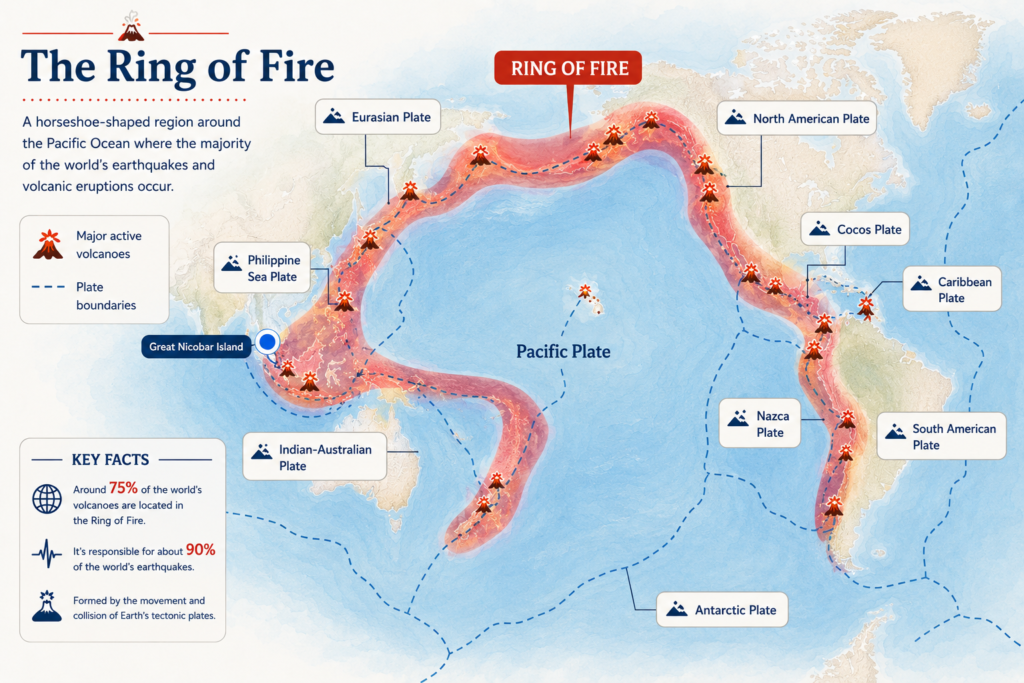
The project is also exposed to considerable geological and climate-related vulnerabilities. Situated within Seismic Zone V and the Pacific Ring of Fire, Great Nicobar Island remains highly prone to earthquakes and tsunamis, with recurrent seismic activity characterizing the broader region. Underscoring these risks, Rear Admiral (Retd.) Sudhir Pillai argued that constructing a major port and airfield in one of the world’s most seismically active areas constitutes “a strategic risk as much as an engineering one,” emphasizing that infrastructure rendered inoperable by seismic events may become “a forward liability rather than a forward base.” These concerns are further compounded by climate-related threats. Rising sea levels, accelerating coastal erosion, and the increasing frequency and intensity of extreme weather events are projected to affect the project’s anticipated 30-year operational horizon, thereby necessitating substantial investments in adaptation and resilience measures. In addition, the islands presently lack the renewable energy capacity required to support large-scale green hydrogen production, constraining India’s long-term aspirations to establish a sustainable maritime bunkering hub.
Beyond environmental considerations, the initiative has generated broader governance and institutional concerns. The National Green Tribunal’s decision to accord judicial deference on the grounds of the project’s strategic significance may establish a precedent whereby future environmentally contentious developments receive comparable exemptions through appeals to national security imperatives. In this regard, former Navy Chief Arun Prakash contended in 2024 that enhancing India’s strategic posture near the Malacca Strait does not inherently necessitate infrastructure expansion on the scale currently envisaged. Rather, existing facilities, including INS Baaz and the natural harbor at Campbell Bay, could potentially achieve similar security objectives while imposing substantially lower ecological costs.
Ultimately, the Great Nicobar Project constitutes one of India’s most significant contemporary strategic undertakings. The extent to which the INR 72,000 crore initiative generates enduring strategic value will depend not only on its economic and security outcomes but also on New Delhi’s capacity to embed environmental sustainability, indigenous rights, and disaster resilience within the project’s foundational framework, rather than addressing these considerations as ancillary mitigation requirements.