BLUF (Bottom Line Up Front)
- Organizations that focus only on immediate risks often miss the cascading consequences that create the greatest business disruption.
- Understanding first-, second-, and third-order effects enables leaders to anticipate how crises evolve across interconnected systems.
- Scenario planning and early warning indicators help organizations move from reactive crisis management to proactive risk anticipation.
Core Argument
Most organizational risk assessments tend to end at the point where an event is identified, and its immediate implications are understood. While this approach provides situational awareness, it often falls short of delivering true strategic insight. Effective intelligence analysis requires going a step further, beyond identifying what has happened, toward interrogating what is likely to happen next.
In today’s highly interconnected operating environment, disruptions rarely remain contained within a single domain. A geopolitical shock, regulatory change, economic disruption, or security incident can trigger a cascade of consequences that propagate across supply chains, financial systems, labor markets, and political environments. These ripple effects frequently prove more consequential than the initial triggering event itself, both in terms of duration and severity of impact.
Organizations that navigate uncertainty successfully are not those that consistently predict events with precision, an inherently difficult if not impossible task, but those that understand how events evolve across systems. They recognize that risk is dynamic rather than static, and they prepare for a range of plausible outcomes rather than a single anticipated trajectory. This shift from event-focused to consequence-focused analysis represents a fundamental evolution in how organizations approach risk in complex environments.
Introduction
When a crisis emerges, attention naturally converges on the immediate threat. An armed conflict breaks out, a government imposes tariffs, a cyberattack disrupts core systems, or a critical shipping route becomes contested. In such moments, decision-makers are under pressure to interpret rapidly unfolding developments and implement measures to mitigate direct impacts. This instinctive focus on the immediate is both understandable and necessary, it addresses what is visible, urgent, and quantifiable.
In late 2023, as attacks on commercial vessels escalated in the Red Sea, this pattern was clearly evident. Initial concerns centered on tangible risks: the safety of crews, the security of cargo, and the viability of critical maritime routes. Headlines focused on naval deployments, rerouted vessels, and rising insurance premiums. For many organizations, the problem appeared contained which was to manage the disruption, absorb increased costs, and maintain operational continuity.
Yet within weeks, the deeper implications began to surface. Shipping delays extended from days into weeks, disrupting tightly calibrated supply chains. Freight costs surged, feeding into already fragile pricing environments and contributing to inflationary pressure. Manufacturers were forced to reassess inventory models, while retailers faced growing uncertainty over stock availability. What began as a localized maritime security issue evolved into a broader economic challenge, influencing sourcing decisions, cost structures, and long-term supply chain strategy.
This progression is not unique to maritime disruption. Whether triggered by geopolitical tensions, regulatory changes, cyber incidents, or economic shocks, crises rarely remain confined to their initial domain. The immediate event marks only the beginning. In the weeks and months that follow, consequences cascade across interconnected systems affecting supply chains, financial markets, labor dynamics, and political environments in ways that are harder to predict and often more difficult to manage.
However, organizational responses frequently remain anchored in the immediate. Immediate impacts are visible and measurable, making them easier to prioritize and address. By contrast, downstream effects are diffuse, evolving, and often ambiguous in their early stages. This creates a critical gap in risk assessment: the tendency to focus on what has happened, rather than on how it will unfold.
Over time, these second- and third-order effects can accumulate into systemic disruptions that exceed the scale of the original event. They reshape operating environments, alter cost structures, and constrain strategic flexibility in ways that are not immediately apparent. This reality underscores a central principle of modern risk analysis: the most visible threat is not always the most consequential one.
For organizations operating in increasingly complex and interconnected environments, this insight carries significant implications. Risk assessment must extend beyond identifying events to understanding their trajectory. It must account for how disruptions evolve over time and propagate across systems. The ability to anticipate these cascading effects, rather than simply react to initial events, has become a defining feature of effective risk management.
In this context, the most important question for decision-makers is no longer simply, “What is happening?” but rather, “What happens next?”
Understanding First-, Second-, and Third-Order Effects
To operationalize this broader perspective, it is useful to conceptualize risk in terms of cascading layers of impact commonly described as first-, second-, and third-order effects. This framework provides a structured way to analyze how an initial event propagates across systems and generates increasingly complex consequences.
First-order effects are the direct and immediate outcomes of an event. These impacts are typically the most visible and are often the primary focus of initial reporting and response efforts. For example, attacks against commercial shipping in the Red Sea created an immediate security threat to vessels transiting the region. Shipping companies responded quickly by rerouting vessels around the Cape of Good Hope, thereby avoiding the high-risk area.
At this stage, the impact appeared relatively contained: increased transit times, higher fuel consumption, and immediate operational adjustments. However, the situation did not end with these initial responses.
Second-order effects began to emerge as the implications of rerouting reverberated through the logistics ecosystem. Longer transit times disrupted delivery schedules, introduced greater uncertainty into supply chains, and contributed to rising freight costs. Companies that relied on tightly calibrated just-in-time inventory systems faced growing pressure, as delays increased the risk of production disruptions. Retailers encountered challenges in maintaining stock levels, while manufacturers were forced to reassess inventory strategies.
Over time, third-order effects became apparent. The cumulative impact of higher transportation costs contributed to broader inflationary pressures, affecting both producers and consumers. Businesses began exploring alternative sourcing strategies to reduce exposure to geopolitical chokepoints, accelerating conversations around supply chain diversification. Investment flows shifted as companies sought more resilient operational models, and strategic planning began to reflect a more fragmented global trading environment.
What began as a localized maritime security challenge evolved into a systemic economic and strategic issue with global implications. This progression illustrates the importance of moving beyond surface-level analysis. Each event exists within a broader ecosystem of interdependencies, and its most significant impacts often lie several steps removed from the original trigger.
The Challenge of Interconnected Risks
The expanding complexity of modern operating environments amplifies the importance of understanding cascading effects. Organizations today operate within deeply interconnected systems, where economic, political, technological, and social dynamics intersect in ways that defy linear analysis.
A policy decision in one jurisdiction can have far-reaching implications across multiple geographies. For instance, regulatory changes can alter investment incentives, disrupt established supply chains, and influence corporate strategy in entirely different regions. Similarly, political instability in a resource-producing country can affect commodity prices globally, shaping production costs, consumer pricing, and profitability across industries.
The relationship between the United States and China provides a useful illustration of these dynamics. At the first-order level, trade tensions manifest through tariffs, export controls, and regulatory restrictions. These measures directly affect trade flows and increase costs for affected industries.
At the second-order level, companies respond by restructuring supply chains, relocating production facilities, or increasing inventory buffers to manage uncertainty. These adjustments reflect attempts to mitigate risk exposure, but they also introduce new inefficiencies and costs.
Over the longer term, third-order effects emerge that extend beyond individual firms. Persistent tensions can influence global investment patterns, redirect technological development, and reshape labor markets. Geopolitical alignments may shift as countries adjust their economic partnerships, further altering the structure of global trade.
As analysts move further away from the initial event, uncertainty inevitably increases. Predicting the precise trajectory of third-order effects is inherently challenging, given the number of variables involved. However, this does not diminish their importance. On the contrary, it is precisely at this level that many of the most strategically significant risks and opportunities emerge.
For organizations, the challenge lies in balancing analytical rigor with uncertainty. Rather than seeking definitive predictions, risk assessment should aim to map plausible pathways through which events may evolve. This requires a shift from deterministic thinking to a more probabilistic and scenario-based approach.
Scenario Planning as a Tool for Anticipating Cascading Effects
Given the inherent complexity and uncertainty associated with cascading risks, organizations cannot rely on prediction alone. Instead, they must adopt methodologies that enable them to explore a range of possible futures and prepare accordingly. Scenario planning offers one of the most effective tools for achieving this objective.
At its core, scenario planning is not about forecasting a single outcome. Rather, it is about constructing multiple plausible futures based on different assumptions and drivers. This approach shifts the central question from “What will happen?” to “What could happen?”, a faint but critically important distinction.
Through scenario planning, analysts identify key drivers of change, critical uncertainties, and decision points that are likely to shape outcomes. These elements are then combined to develop distinct scenarios that capture a range of potential trajectories. Each scenario is internally coherent and grounded in current realities but differs in how key variables evolve.
For example, an organization assessing trade tensions might develop scenarios that include gradual de-escalation, prolonged competition, and significant escalation. In a de-escalation scenario, companies may benefit from reduced regulatory friction and expanded market access. In a prolonged competition scenario, businesses may face sustained uncertainty, requiring ongoing adjustments to supply chains and investment strategies. In an escalation scenario, disruptions could intensify, leading to more pronounced decoupling and structural shifts in global trade.
A similar approach can be applied to geopolitical flashpoints such as the potential conflict between Taiwan and China. Organizations with exposure to East Asian markets may construct scenarios ranging from continued cross-strait stability and diplomatic management to heightened military tensions or even direct confrontation. While a stable scenario would preserve existing trade and investment flows, a crisis scenario could trigger severe disruptions in semiconductor supply chains, maritime shipping routes, financial markets, and broader regional security dynamics. The cascading effects would likely extend far beyond East Asia, influencing global manufacturing, technology industries, energy markets, and international political alignments.
The value of scenario planning lies not in identifying the “correct” scenario, but in preparing the organization to operate effectively across multiple outcomes. By exploring how each scenario would affect operations, costs, regulatory exposure, and strategic positioning, organizations can develop contingency plans and build flexibility into their decision-making processes.
In this way, scenario planning transforms uncertainty from a source of vulnerability into a manageable aspect of strategic planning. It enables organizations to move beyond reactive responses and toward proactive preparedness.
The Importance of Early Warning Indicators
While scenario planning enables organizations to map potential futures, its value ultimately depends on the ability to identify which of those futures is beginning to materialize. This is where early warning indicators become critical. These observable signals, often subtle in isolation, provide insight into shifting conditions and emerging risks. Acting as a bridge between strategic foresight and operational decision-making, they allow organizations to move from passive monitoring to active anticipation, adjusting assumptions and actions as conditions evolve.
Early warning indicators vary across industries, reflecting different risk profiles and operating environments. However, their core purpose remains consistent: to provide advance visibility into change, enabling decision-makers to intervene before disruptions reach critical thresholds. The objective is not to track every possible signal, but to focus on a targeted set of indicators closely linked to key risk drivers and scenarios. For indicators to be effective, they must be specific, measurable, and actionable.
In logistics and supply chains, indicators are often tied to flow and cost dynamics. Changes in shipping volumes, freight rates, or vessel routing patterns can signal emerging disruption. Similarly, port congestion, customs delays, and rising insurance premiums may indicate growing bottlenecks or heightened risk exposure. Sustained rerouting away from a corridor, for example, may reflect not just a temporary adjustment, but a longer-term shift in perceived risk.
In the energy sector, indicators typically center on supply conditions and geopolitical developments. Movements in oil and gas prices, reports of production cuts, or infrastructure disruptions such as pipeline closures or refinery outages can signal tightening supply. Policy changes, including export restrictions, often provide early signs of market realignment, with localized disruptions quickly cascading into broader price volatility.
Financial sector indicators focus on market sentiment and liquidity conditions. Sharp movements in bond yields, currency volatility, or equity corrections can indicate underlying instability. Changes in credit availability or rising default rates may signal stress within specific sectors. Regulatory developments can also reshape market behavior well before their full impact is apparent.
In the technology and cybersecurity space, indicators often emerge from evolving threat activity. Increases in intrusion attempts, phishing campaigns, or vulnerability disclosures may signal heightened risk. Shifts in ransomware tactics or targeted industries can provide insight into changing threat priorities, enabling organizations to strengthen defenses in advance.
In regulatory environments, early signals often take the form of policy proposals, consultations, or changes in political rhetoric. While formal implementation may take time, these developments can influence market behavior immediately. Organizations that track these signals closely are better positioned to adjust compliance strategies and investment decisions.
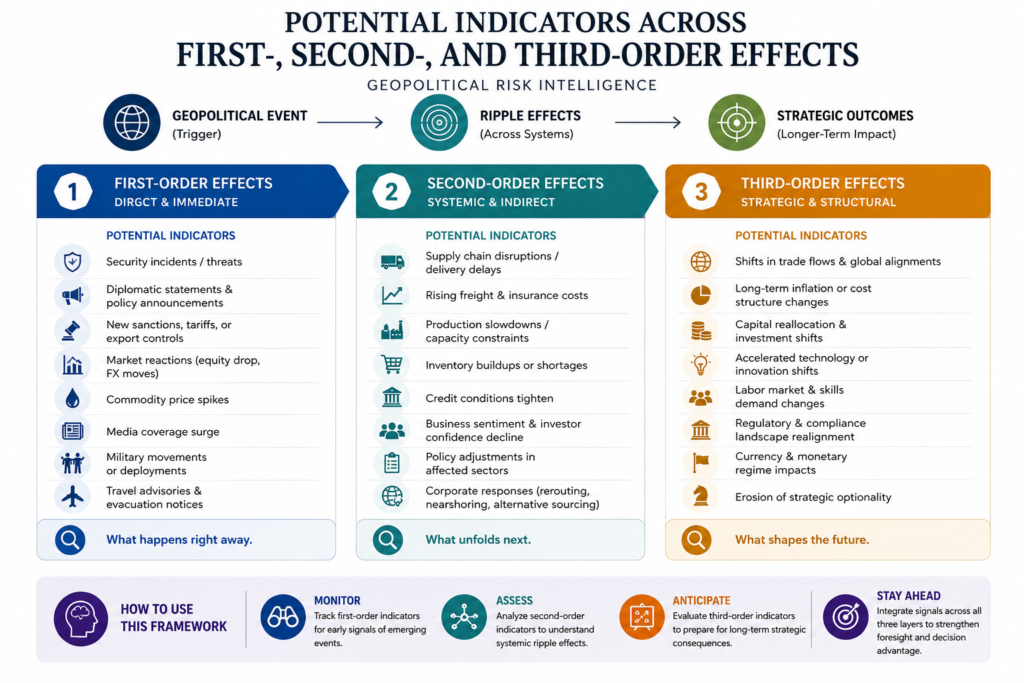
Note: This infographic is AI-generated and intended for illustrative purposes only
Importantly, early warning systems are not designed to deliver perfect foresight. Their value lies in creating a decision advantage. By identifying change early, organizations gain time to reassess assumptions, activate contingency plans, and reposition strategically before disruptions fully materialize. Even modest lead time can significantly enhance resilience.
To be effective, indicators must be embedded within decision-making processes. Without this integration, monitoring risks becoming informational rather than actionable. When properly implemented, early warning indicators transform risk management from a reactive function into a forward-looking capability, enabling organizations not just to respond to change, but to anticipate it as it unfolds.
Conclusion
Risk analysis is often framed as the process of identifying threats. While this is a necessary first step, it captures only a portion of the discipline’s true value. The greater strategic advantage lies in understanding consequences specifically, how risks evolve over time through cascading first-, second-, and third-order effects.
The most significant disruptions rarely stem from the initial event itself. Instead, they emerge from the complex chain of consequences that follow, often extending far beyond the original context. These downstream effects can reshape operating environments, alter cost structures, and influence strategic decision-making in ways that are not immediately apparent.
Organizations that incorporate this broader perspective into their risk frameworks are better positioned to navigate uncertainty. By leveraging scenario planning, they can explore a range of plausible futures and prepare for diverse outcomes. By monitoring early warning indicators, they can detect emerging shifts and respond proactively. And by recognizing the interconnected nature of modern systems, they can anticipate how disruptions in one domain may propagate across others.
In an increasingly complex and uncertain world, the ability to anticipate consequences is becoming just as important as the ability to identify risks. For decision-makers, the critical question is no longer simply, “What is happening?” but rather, “What happens next?”